Adenium: The Desert Rose

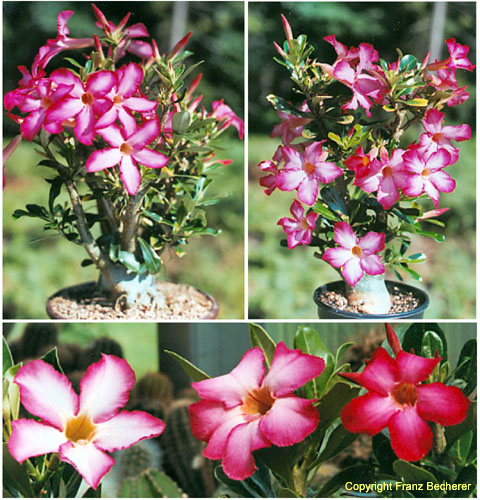
Adenium obesum (Desert rose)

This 20-year-old 22-inch-high succulent was grown from seed in a nursery in a 10-gallon tub. Over a period of several years the tree was groomed and its roots were slowly raised in a training container. Branches were pruned to create Y-formation growth and rebranching, and they were carefully bent using aluminum bonsai wire. It is currently staged in a 16- by 14-inch glazed olive-green bonsai container. The plant receives full sun, and when it's not dormant, it is watered so that the soil is evenly and moderately moist.

Adenium obesum Bonsai
Adenium is a genus coming from eastern Africa and southern Arabia. Depending on the authors, there is either one species, Adenium obesum, with several subspecies, or up to eight separate species. Adenium as they age develop a attractive gnarled caudex, and many cultivars and hybrid exists with spectacular blossoms. The flowers are funnel shaped, and are produced in most of the growing season.
Adenium like full sun in summer, and they generally do better then, and bloom much more, with regular water and fertilizer. In winter they should stay above 45°F (7°C) at night with higher day temperature. They are then dormant and should be watered sparingly (although not kept bone dry). Depending on the variety and on the conditions they are kept in, they can be partially or totally deciduous in winter. Adenium generally rot from the bottom of the stem. When buying an adenium, it is often a good idea to check the firmness of the stem.
Eventually, most cultivar, in the ground, can reach 6 feet tall (1.8 m). They stay much smaller when raised in container, and make excellent patio plants when the climate is appropriate.
posted by KuliMaya @ 10:48 PM


1 Comments:
At 11/24/2009 11:07:00 AM, Anonymous said…
adeniumatoz.blogspot.com is very informative. The article is very professionally written. I enjoy reading adeniumatoz.blogspot.com every day.
payday loans vancouver payday
Post a Comment
<< Home